Is Padel Replacing Tennis? Market Trends & Gear
Disclosure: RacketEdge is an Amazon Associate and earns from qualifying purchases.
Padel is not replacing tennis, but it is growing rapidly alongside it. Padel is played on smaller glass-walled courts in doubles format, making it highly social and easy for beginners. To transition, players need a solid padel racket (racquet) and low-bounce padel balls.
Walk into any racket sports club in Spain, Sweden, or Argentina, and you will notice something immediate: tennis courts are being demolished and replaced by glass-walled padel courts. The sport has exploded across Europe and is now growing in the United States.
This rapid growth has triggered debates among sports club managers: is padel replacing tennis? Will tennis eventually become a niche sport played only by purists, while the masses transition to padel and pickleball? Understanding Is padel replacing tennis what gear players need is a key question for racket sports clubs and active players.
The short answer is no—tennis remains the global king of racket sports. However, padel is capturing a massive share of recreational players. If you are an active tennis player curious about the trend, transitioning requires a completely different set of equipment.
1. Court & Equipment Comparison (Statics)
To understand the differences in scale and physics between the two sports, study the structural parameters (statics) of their court layouts and equipment designs:
| Design Category | Padel Court & Gear Specs | Tennis Court & Gear Specs | Playability Profile |
|---|---|---|---|
| Court Dimensions | 10 meters x 20 meters | 23.77 meters x 10.97 meters | Padel is 25% the size of a tennis court |
| Total Playing Area | 200 m² (enclosed by glass/mesh) | 260.8 m² (excluding run-off areas) | Tennis requires 3x more physical court space |
| Racket Construction | Solid (No strings), EVA foam core | Stringed hoop (Graphite layup) | Padel relies on core compression |
| Racket Length | 45.5 cm (18 inches) | 68.6 cm (27 inches) | Padel is shorter, improving control |
| Racket Weight | 350g to 385g (Heavier) | 280g to 340g | Padel is heavier but has lower swingweight |
| Ball Pressure | 10.0 to 11.5 PSI (Lower) | 14.0 to 15.0 PSI (Higher) | Padel ball has a slower, lower bounce |
| Outsole Pattern | Herringbone (Omni-court sand) | Modified Herringbone (Hard concrete) | Padel turf requires clay-style grip |
| Court Build Cost | ~$25,000 to $35,000 | ~$60,000 to $90,000 | Padel requires less land preparation |
| Revenue Footprint | 3 courts fit in 1 tennis court | 1 court | Padel accommodates 12 players in 1 tennis space |
2. Why Padel Is Growing: The Social Advantage
To understand why padel is booming, we must look at court geometry. A tennis court is large (78 feet long) and requires extensive physical coverage. Padel courts are much smaller (10x20 meters) and enclosed by glass and wire mesh walls.
For a beginner, tennis has a steep learning curve. It takes months of coaching to develop the control needed to maintain a 10-shot rally. In padel, because the racket is short and the court is enclosed, beginners can maintain long, exciting rallies during their very first session. The game is less physically demanding on joint acceleration but highly dynamic, making it appealing to older players and families.
- Rally Lengths: The walls keep the ball in play; rallies last longer immediately.
- Doubles Format: Padel is doubles-only, creating a highly social environment.
3. The Club Economics: Why Managers Love Padel
From a commercial standpoint, the growth of padel is driven by club economics. According to reports published by the International Padel Federation (FIP):
- Global Expansion: Padel is active in over 90 countries with over 25 million active players, making it the fastest-growing racket sport globally.
- Land Utilization: A standard singles tennis court footprint (including run-off zones) can accommodate three padel courts.
- Revenue Multiplication: Instead of 2 to 4 players paying fees on a single tennis court, a club manager can host 12 players simultaneously in the same square-footage footprint, multiplying court rental revenue by 300% to 400%.
Meanwhile, the International Tennis Federation (ITF) Global Tennis Report states that while tennis has over 87 million active players worldwide, the integration of padel and beach tennis inside traditional tennis clubs is a key strategy to expand overall racket sport participation.
4. What Gear Do Padel Players Need?
If you decide to step onto a padel court, your tennis gear will not work. Here is the essential equipment checklist:
A. The Padel Racket (Bat)
Unlike tennis rackets, padel rackets have no strings. They are solid, measuring approximately 18 inches long, and feature a perforated face drilled with holes to reduce air resistance.
Inside the racket is an EVA foam or polyethylene core, wrapped in carbon fiber or fiberglass.
- Soft Rackets (Fiberglass + Polyethylene): Offer a comfortable feel and absorb shock, making them ideal for beginners.
- Stiff Rackets (Carbon Fiber + EVA Foam): Offer high control and power for advanced players who swing fast.
B. Padel Balls
Padel balls look identical to tennis balls (yellow felt), but they are pressurized differently. Padel balls have an internal pressure of 10 to 11.5 PSI, compared to 14 to 15 PSI for tennis balls. This lower pressure slows down the ball, keeping it manageable within the glass walls.
C. Padel Shoes (Clay Court Shoes)
Padel courts are made of monofilament turf covered in fine sand. This sand makes the court slippery. To play safely, you need shoes with a herringbone (clay court) tread pattern that can grip the turf and slide predictably.
5. Conclusion: Co-Existence, Not Replacement
Padel is not replacing tennis; it is expanding the market for racket sports. While tennis remains the ultimate test of athletic endurance and classic technique, padel offers a highly accessible, social alternative. For club players, playing both sports is an excellent way to maintain hand-eye coordination and cardiovascular fitness.
Recommended Gear Mentioned in This Guide
Yonex EZONE 100 / Babolat Pure Drive
*RacketEdge is an Amazon Associate. We earn a commission on qualifying purchases.
Wilson Blade 98 v9
*RacketEdge is an Amazon Associate. We earn a commission on qualifying purchases.
Frequently Asked Questions
What is the difference between a tennis racket and a padel racket?
Tennis rackets are larger, have string beds, and weigh 300g. Padel rackets (often called padel bats) are solid, have no strings, are perforated with holes, and feature a foam core wrapped in carbon fiber.
Can I use tennis balls to play padel?
No. While they look identical, padel balls have less internal pressure, resulting in a lower bounce. Using tennis balls in padel makes the game too fast and bouncy off the glass walls.
Why is padel growing faster than tennis?
Padel is easier for beginners to learn because the racket is short and close to the hand, and the court is enclosed, meaning you spend less time chasing errant balls.
Do you need special shoes for padel?
Yes. Padel courts are made of artificial grass filled with sand. You need shoes with a deep herringbone tread pattern (similar to clay court tennis shoes) to prevent slipping.
Is padel played in singles or doubles?
Padel is almost exclusively played in a doubles format. The court is too small for singles play, which helps make the sport highly social.
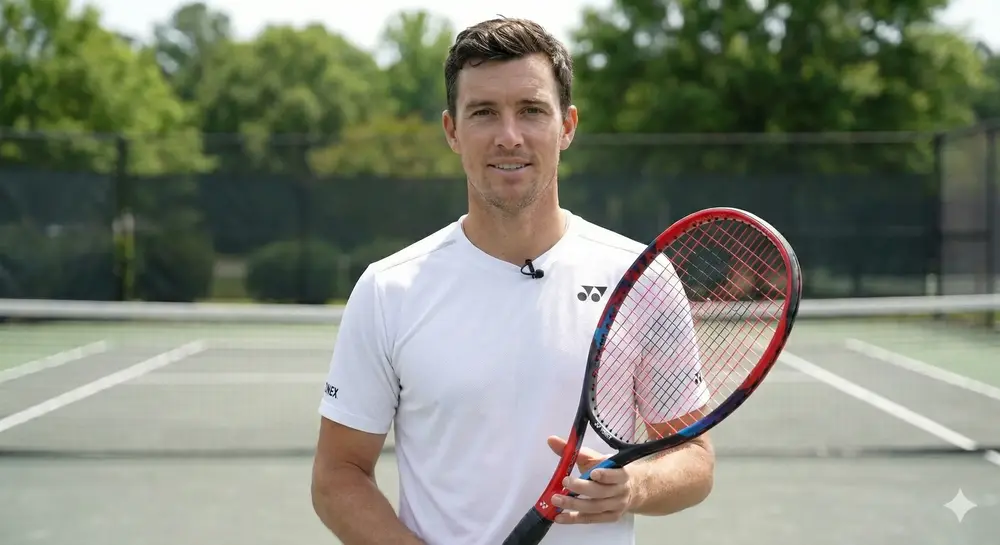
Chris Davies
Chris Davies conducts on-court playtesting and technical reviews to write guides for intermediate and advanced players. His reviews are grounded in baseline tests.